
Soviet and U.S. Space Suits
Soviet and U.S. Space Suits
Space suits serve as self-contained spaceships that protect astronauts from extreme temperatures, micrometeoroids and the nearly pure vacuum of space for hours at a time.
Event Access:
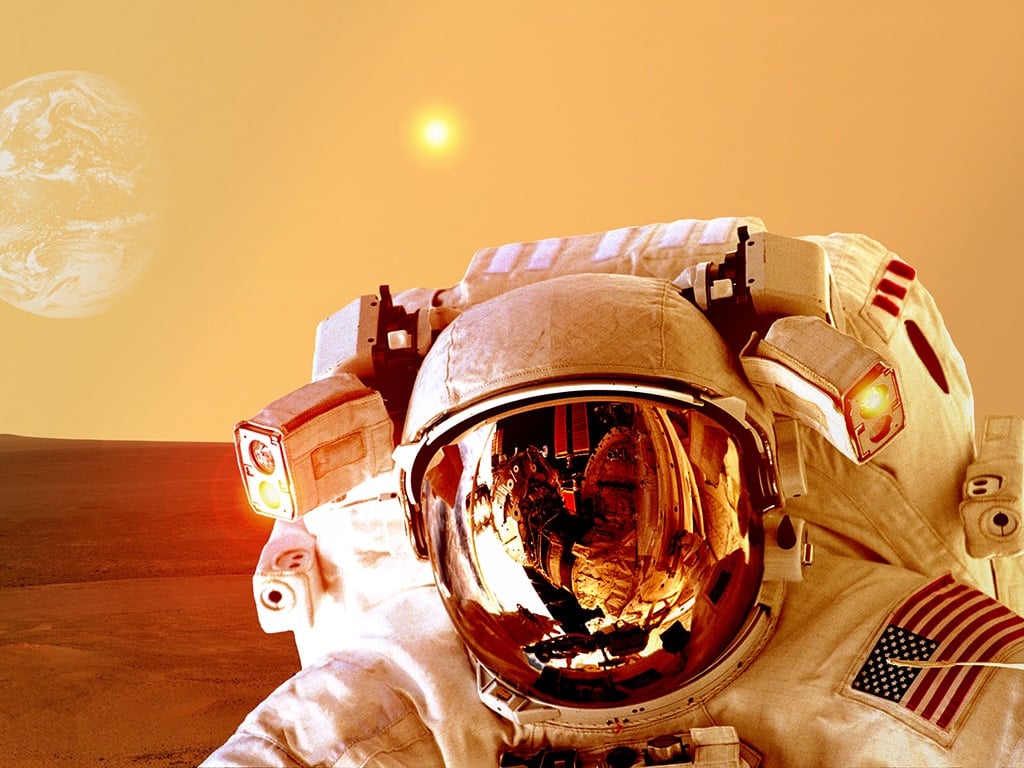
Space suits serve as self-contained spaceships that protect astronauts from extreme temperatures, micrometeoroids and the nearly pure vacuum of space for hours at a time, so that they can take a stroll outside the confines of their spacecraft or enjoy a brisk walk on the Moon. Space suits shouldn’t be confused with the pressure suits worn by astronauts, test pilots and others during launch and landing. Those slimmer, lighter-weight suits provide some protection if there is a sudden need to bail out or eject from a disintegrating vehicle as it soars through the rarified atmosphere high above Earth.
United States – Extravehicular Mobility Unit (EMU)
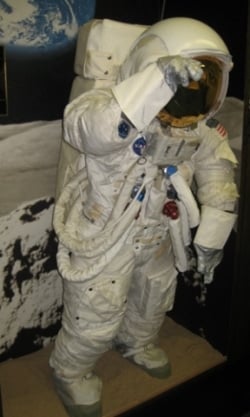
 The U.S. Extravehicular Mobility Unit (EMU) has everything an astronaut needs to stay alive during a spacewalk, including a fruit bar snack mounted inside within easy reach of a hungry mouth. The EMU has 18,000 parts, including a helmet with three different visors for changing light conditions. Its 14 layers include one strong enough to provide protection from micrometeoroids traveling at 17,000 mph (27,358.85 kph). EMUs provide pressure, oxygen, water, temperature control, carbon dioxide removal and radiation protection when astronauts are outside the spacecraft.
Introduced in 1982, the EMU is a two-piece semi-rigid suit, and is currently one of two spacesuits used by crew members on the International Space Station (ISS), the other being the Russian Orlan space suit. It was used by NASA’s Space Shuttle astronauts prior to the end of the Shuttle program in 2011. It consists of a hard upper torso assembly, a primary life support system, arm sections, gloves, an Apollo-style “bubble” helmet, the extravehicular visor assembly and a soft lower torso assembly that incorporates a body seal closure, waist bearing, brief, legs and boots.
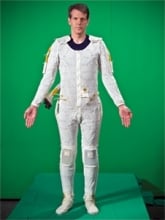 Prior to donning the pressure garment, the crew member puts on a maximum absorbency garment (basically a modified diaper) and possibly a thermal control undergarment (long johns). The final item donned before putting on the pressure suit is the liquid cooling and ventilation garment (pictured, right) that circulates chilled water through plastic tubing for body temperature control.
The EMU replica on display at the El Pomar Space Gallery was manufactured by Guard~Lee and donated by Hamilton Sundstrand Space Systems International. The actual EMU is manufactured by Dover and Hamilton Standard.
For more information, click here.
Russia – Sokol Space Suit-K
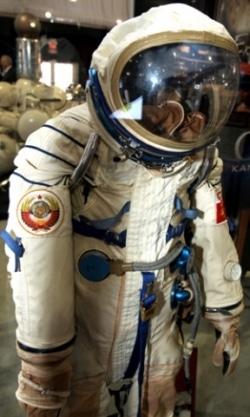
 The Soviet-developed Sokol pressure suit, which is still used by Russia today, was first worn by Soviet cosmonauts in 1973, and is similar in function to the pumpkin-orange pressure suits that were worn by U.S. astronauts during launch and landing of a Space Shuttle. The Sokol suit was not made for cosmonauts to use during spacewalks. Instead, they wear an Orlan suit, the Russian equivalent of the American EMU. Sokol is the Russian word for falcon.
Designed in response to the suffocation death in 1971 of three cosmonauts aboard the Soyuz 11 mission to the Soviet Space Station Salyut, the Sokol space suit was first worn by Soviet cosmonauts in 1973. Unlike bulky EMU (spacewalk) suits, the sleek Sokol suit can be worn in the exceptionally tight quarters aboard the Soyuz spacecraft where there is no room for cosmonauts to wear extensive life support equipment.
The suit, which weighs 22 lbs. (10 kg), consists of an inner pressure layer of rubberized polycaprolactam and an outer layer of white nylon canvas. Boots are integrated with the suit, but gloves are removable and attached by blue anodized aluminum wrist couplings. The polycarbonate visor can open on hinges mounted near the ears and seals with an anodized aluminum clavicle flange; the hood folds when the visor is raised. The suit has four pockets and adjustment straps on the arms, legs, chest and abdomen.
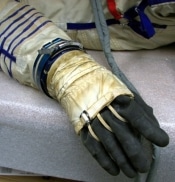 The Sokol has a suit pressure gauge on the left wrist and a mirror on an elastic wrist band that helps the wearer see things otherwise outside his/her field of view. During re-entry, an altimeter on a wrist strap may also be worn to measure cabin pressure and alert the wearer when to brace for touchdown. A wristwatch is often worn as well, with an elastic wrist band replacing the strap so it may fit over the bulky suit glove.
Electrical cables are mounted on the right abdomen of the suit; separate hoses for air and oxygen are on the left. An electric blower ventilates the suit with cabin air and, if the cabin pressure drops, the air supply is automatically replaced with oxygen from pressurized bottles. Air and oxygen exhaust through a pressure relief valve at the center of the chest.
The suit is intended to be worn for up to 30 hours in a pressurized environment or two hours in a vacuum; it can also float and has a neck dam that allows the visor to be raised in water without the risk of flooding the suit.

The prototype Sokol Space Suit-K on display at the El Pomar Space Gallery was used for on-ground engineering and thermal vacuum tests during cosmonaut training. It was manufactured by NPP Zvezda in 1973 and is on loan from the Kansas Cosmosphere and Space Center.
Pictured, left, Space Foundation Special Advisor – Human Spaceflight Dr. Leroy Chiao in the Sokol suit he wore on his mission aboard a Russian Soyuz spacecraft to the international Space Station.
Suits are Similar to Apollo-Era Suits
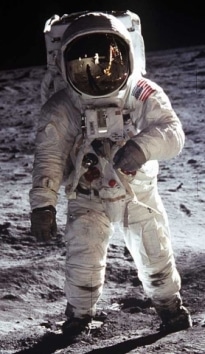 The suits on display at the El Pomar Space Gallery are not from the Apollo era, but performed similar functions as those worn by astronauts exploring the Moon.
The Apollo space suit, which played the role of both pressure suit and (with additional layers) EMU, included:
- A water-cooled nylon undergarment
- A multi-layered pressure suit: inside layer – lightweight nylon with fabric vents; middle layer – neoprene-coated nylon to hold pressure; outer layer – nylon to restrain the pressurized layers beneath
- Five layers of aluminized Mylar interwoven with four layers of Dacron for heat protection
- Two layers of Kapton for additional heat protection
- A layer of Teflon-coated cloth (nonflammable) for protection from scrapes
- A layer of white Teflon cloth (nonflammable)
- Boots, gloves, a communications cap and a clear plastic helmet
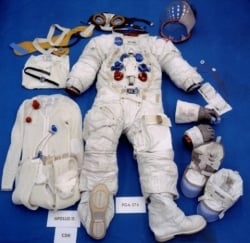 For walking on the Moon, the Apollo space suit was supplemented with a pair of protective overboots, gloves with rubber fingertips, a set of filters/visors worn over the helmet for protection from sunlight, and a portable life support backpack that contained oxygen, carbon dioxide removal equipment and cooling water. The space suit and backpack weighed 180 lbs. (82 kg) on Earth, but only 30 lbs. (14 kg) on the moon.
Each Apollo suit was made to fit (custom tailored) each astronaut, unlike the later EMUs that came in several stock sizes and could be adjusted to fit the astronaut.
For more information, click here.